About Me
- JoAnn Gaunt
- Leawood, Kansas, United States
- Before deciding to become a Band Instrument Repair Tech, I studied music at Fort Hays State University (Hays, Kansas). I received my B.A. in music from them. There I studied Saxophone and Clarinet under Dr. Kristen Pisano. I also studied voice under Dr. Joe Perniciaro, and Jazz Improvisation under Brad Dawson. I am a member of Sigma Alpha Iota, a music fraternity, and I served as the FHSU chapter Vice President of Rituals. While in high school I earned many of my undergraduate hours at Barton County Community College. There I studied saxophone with Steven Lueth and piano with Karole Erickson. I also graduated with a diploma of Band Instrument Repair from Southeast Technical College in Red Wing, Minnesota in 2011.
Monday, May 16, 2011
Saturday, May 14, 2011
Monday, March 14, 2011
Today was the first day back in woodwind class. I am glad to be there! We started by reviewing the clarinet. Then we talked about doing play and conditions versus overhauls. It will be hard trying to decide which things to fix, and which things to let go. We also discussed how to evaluate instruments in front of customers, and what to say to them. It is always best to estimate high so you don't have to call later and tell them the repair is going to cost more than the estimate.
Monday, February 28, 2011
Today I also did some cosmetic work on a trumpet for extra credit. The trumpet is silver plated, and the mouth-pipe had been replaced. There were parts where the plating had been buffed away, so I re-buffed those areas and spot-plated the trumpet.
Wednesday, February 9, 2011
Brass class is flying by. I am working on a french horn and a trombone right now. There are separate pages for each, so be sure to look at those! Things I have been learning include porting and stringing rotary valves, aligning trombone hand-slides, and taking dents out of trombone hand-slides.
I learned an important lesson with Greg (my instructor) today. The brace that goes from the Trombone bell to the gooseneck isn't always a solid piece. It can be hollow, and if you chuck it in a soft jaw vise, you can crush it. To fix it, we have to cut the tube, restore the area, and then solder it with a ferrule back on. Since it was Greg's idea, he is going to help me fix it.
Thursday, February 3, 2011
Sunday, January 30, 2011
The Conn Victor is all patched up! The second valve slide is still stuck, but I am sticking penetrating oil on it daily, and hoping I can get it unstuck without unsoldering the crook. I have pictures of the patch work i did on the mouth pipe. I also did a little work on the pistons. They were mashed up on the bottom ends. It still needs a polishing, a play test, and the second slide unstuck, but it is otherwise finished!
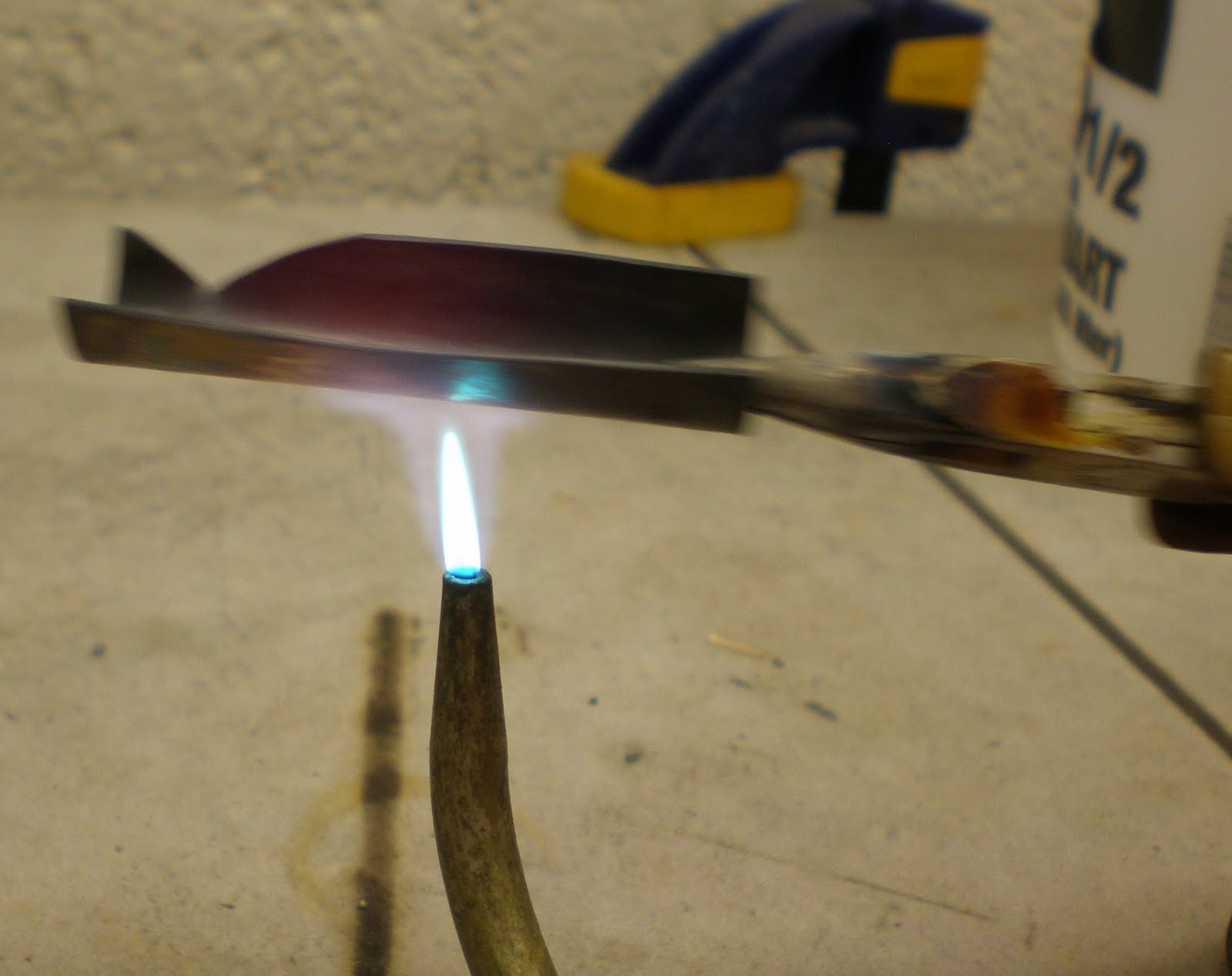
I started with a card stock pattern, and then cut it out of nickel silver
I annealed the pice, then started forming it on a mandrel
This is what happens to your finger when you don't have good aim
I had to tin the inside of the patch before I soldered it
The end product looked like this
I also soldered on the a missing piece from the main tuning slide and did some dent work on the pistonsWednesday, January 19, 2011
I have another extra credit project! It is a conn victor coronet that was made in 1929! The mouth pipe is in rough shape. There was a mouthpiece stuck in it, and when I pulled the mouthpiece, the receiver fell off! The receiver end is bent, and has a small tear on the underside. It has a small amount of red rot as well, but I am not going to replace it. I will patch the tear, and straighten the mouth pipe.
I spent several hours cleaning the coronet. It had lots of lime, scale, and corrosion. The only part that is still stuck is the 2nd valve slide. I'll continue to work on it in my spare time, and keep you updated.
We got our Horns today!! I played a horn for the first time ever. It was fun! We learned about how to oil them, and soon we will learn how to string them.
Also, we have been learning a lot about casing and piston repair. I got some practice today on taking a dent out of a casing. We talked about how to tell if a casing is dented, or if a piston is bent or out of round. Pistons can also be obstructed by things kids decide to put in their instrument, such as paper clips or tooth picks. Pistons can also jam because of bends in the body, slides, or stems.
Sunday, January 16, 2011
On Friday we made a flute push rod tool on the lathe. We used a nylon plastic. We faced each end, drilled a hole in one end for pushing out a head cork, and then we put a small mark on the other end 17 mm from the end (like you would see on a flute cleaning rod) for installing head corks. 17 mm is standard placement for a head cork on a student line flute.
Monday, January 10, 2011
Second semester began today! I am back in brass class and reviewing dent work and other things this week. Our teachers did a clinic on how to tell band directors to fix things today. I have a very valuable resource for all of my band director & musician friends!
redwingmusicrepair.org/band/resources.html
Check out the "It's gotta work now!" videos. There is valuable information about getting instruments through a concert or rehearsal without causing them further damage. You will be surprised at how much money you save the school district or a student, just by knowing what causes further damage and what does not. I was also amazed to see how many wrong things I have seen go on in my years as a student.
Band director, also be sure to educate your students on instrument maintenance. Also make sure they know that if they are having a problem they should bring their instrument to you, and not try fixing it themselves.
P.S. this is what happens to instrument finishes (plating or lacquer) when you use rubber bands to hold water keys shut! Damage can start within a day or two!!
redwingmusicrepair.org/band/resources.html
Check out the "It's gotta work now!" videos. There is valuable information about getting instruments through a concert or rehearsal without causing them further damage. You will be surprised at how much money you save the school district or a student, just by knowing what causes further damage and what does not. I was also amazed to see how many wrong things I have seen go on in my years as a student.
Band director, also be sure to educate your students on instrument maintenance. Also make sure they know that if they are having a problem they should bring their instrument to you, and not try fixing it themselves.
P.S. this is what happens to instrument finishes (plating or lacquer) when you use rubber bands to hold water keys shut! Damage can start within a day or two!!
Friday, December 3, 2010
I started with a piece of steel drill rod that was the same size as my original hinge rod. I filed down the part that I was going to thread to the correct size, and then ran a die on to it. Then I checked the fit on the keys and marked where to cut each end. I beveled my threaded end, and cut a notch in the other end for a screw driver. It was very successful!
Wednesday, November 17, 2010
I handed in my clarinet today!!!! It was a lot of work, but it plays great now!!!!
We started learning about flutes this week. We started by disassembling and reassembling them. Yesterday we learned about regulation of the flute. The flute has five regulations. We regulated our methods flutes, and then we learned how to get rid of lost motion in the keys.

Today we made a valve stem on the lathe. We applied all the things we have learned about lathe work thus far into making them. We had to face the ends, make it a specific length, face part of it to a smaller diameter, and drill, tap, and die threads on the ends. Later we will buff and lacquer them.
We started learning about flutes this week. We started by disassembling and reassembling them. Yesterday we learned about regulation of the flute. The flute has five regulations. We regulated our methods flutes, and then we learned how to get rid of lost motion in the keys.
Today we made a valve stem on the lathe. We applied all the things we have learned about lathe work thus far into making them. We had to face the ends, make it a specific length, face part of it to a smaller diameter, and drill, tap, and die threads on the ends. Later we will buff and lacquer them.
Tuesday, November 2, 2010
We got our clarinet projects today!! Mine has a chipped tenon, and it looks like some of the hinge rods and pivot screws are corroded shut. I'll be disassembling and cleaning it tomorrow. Look for updates on that in my "Project Clarinet" page.
The last couple days we have been learning how to swedge keys and adjust point screws to fit keys (this means getting rid of end and lateral play). We have also learned how to straighten bent hinge rods and hinge tubes. The video in this post is me straightening a hinge rod using the bench motor.
Most of my updates for the next week or so will be in the "Project Clarinet" page so keep an eye on that!
Monday, October 25, 2010
We practices corking all morning (notice the pile of cork on my bench, and all of the used razor blades). I am already getting much better at it! This afternoon we learned more about regulation. There are two points of regulation on the clarinet (meaning 2 or more pads closing from one point of action). We learned how to bend touch pieces and the bridge to get the right pads to close exactly together.
Sunday, October 24, 2010
Sunday, October 17, 2010
Brass class ended well. I spent the rest of the week working on a trumpet that belongs to one of the lunch ladies at school! It is a King 601. It had stuck slides, stuck valve caps, red rot in the mouth pipe, and dents that needed to be removed. I unstuck everything except for the main & second tuning slides and then chem flushed it. After three days with penetrating oil the slides still had not moved so I cleaned the trumpet in the ultrasonic cleaner. After the cleaning, more penetration oil, and some pulling tools I got both slides unstuck. I had to replace the mouth pipe because the red rot was so bad. I used a silver plated mouth pipe that was an extra in the shop in order to save her some money. The king outer tuning slide did not go on that pipe as far as the pipe's original one, so I had to spot plate it. It was so neat!!!! I'm not finished with the project, but I will work on it when I return to brass class!
Subscribe to:
Posts (Atom)